

Electronic Proof of Delivery (ePOD) Software: The Complete Guide
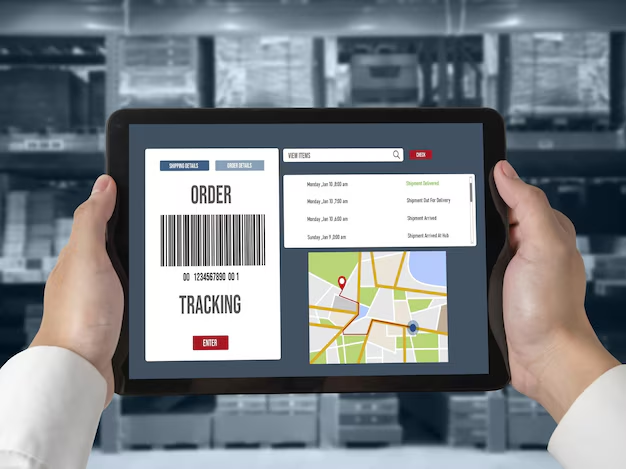
ePOD software — electronic proof of delivery software — captures delivery confirmation digitally at the doorstep: the recipient’s signature, a photo, the receiver’s name and CNIC/ID, and a barcode scan of the consignment, each stamped with the delivery time. It replaces paper delivery sheets with a record you can search, audit and attach to an invoice.
Every delivery dispute costs money. A customer claims a parcel was never delivered. The courier company has no evidence beyond a driver's word. A refund or reship follows. Multiply this by dozens of disputed deliveries per month and you have a significant revenue leak — one that electronic proof of delivery software is designed to prevent entirely.
This guide covers what ePOD software is, how it compares to paper-based systems, which features matter, the legal standing of digital delivery records, and how ePOD integrates with broader delivery management platforms.
What Is Electronic Proof of Delivery?
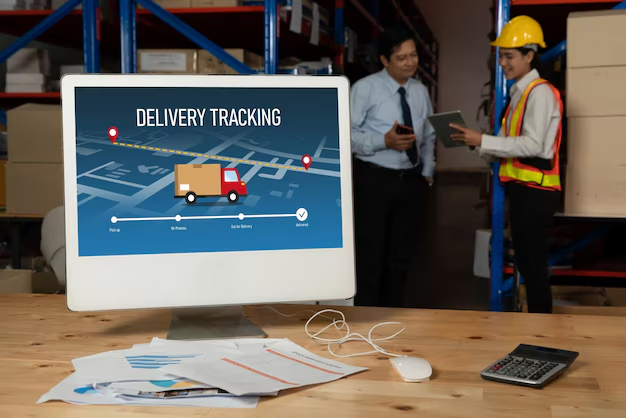
Electronic proof of delivery (ePOD) is the practice of capturing and storing digital evidence that a delivery was completed — including the time, location, and condition of delivery — using a mobile device. The evidence is timestamped, geotagged, and stored in a cloud system accessible to the delivery company and, where relevant, its clients.
ePOD replaces paper delivery receipts, physical signature books, and the manual process of matching paper POD documents to shipment records. It is a standard feature in modern last-mile delivery software and a practical requirement for courier companies operating at any meaningful scale.
The scope of ePOD evidence typically includes:
Map display with all active drivers — dispatcher can see every driver's current position, current stop, and queue
Photograph of the delivered parcel at the delivery location
Customer signature captured on the driver's smartphone screen
GPS coordinates of the delivery location at the moment of capture
Timestamp (date and time of delivery)
Driver identity (which driver completed the delivery)
Customer identity verification (name entry, PIN, or ID check where required)
Together, these elements create an auditable delivery record that is far more reliable than any paper system.

Paper vs. Electronic Proof of Delivery
The limitations of paper-based POD systems are well-documented:
| Dimension | Paper POD | Electronic POD |
|---|---|---|
| Retrieval speed | Hours to days (manual search) | Instant (searchable database) |
| Evidence quality | Signature only, often illegible | Photo + signature + GPS + timestamp |
| Loss/damage risk | Physical documents can be lost | Cloud-stored, backed up |
| Billing cycle | Delayed (wait for paper return) | Same-day (data available immediately) |
| Dispute resolution | Slow, often inconclusive | Fast, evidence-based |
| Cost | Printing, storage, admin time | Driver smartphone + software |
| Scalability | Linear cost growth | Fixed software cost |
For a courier handling 200+ deliveries per day, the administrative overhead of managing paper PODs — filing, searching, matching to invoices — is substantial. Operations teams routinely report that switching to ePOD saves 1–3 hours of administrative work per day.
The billing cycle benefit is often underappreciated. With paper POD, invoices to clients must wait until paper manifests return to the office and are reconciled — often a 2–5 day delay. With ePOD, delivery confirmation is available in real time, enabling same-day or next-day invoicing and significantly improving cash flow.
iCargos ePOD Capabilities
iCargos includes a full ePOD module as a core component of its delivery management platform. The ePOD system captures photo, signature, GPS coordinates, and timestamp at every delivery stop. Data is stored in cloud infrastructure with tamper-evident logging and is accessible immediately through both the dispatcher dashboard and client reporting portals.
The iCargos driver app is mobile ePOD software built for the field: it captures electronic proof of delivery right at the doorstep — the recipient's signature, a photo, the receiver's name and CNIC/ID, and a barcode scan of the consignment — each stamped with the delivery time. The signature image then appears on the parcel's public tracking page, so the merchant and the buyer see the same proof, and the delivered status flows straight into COD settlement.
For MENA-based operations, iCargos ePOD records include Arabic-language delivery notes and support address enrichment — GPS coordinates captured at delivery update the system's address records, improving routing accuracy for future deliveries to the same location.
Courier companies using iCargos report that ePOD implementation reduces delivery dispute resolution time from days to minutes and effectively eliminates the category of disputes where delivery evidence is unavailable.
Summary
Electronic proof of delivery is one of the highest-ROI investments a courier company can make. The direct benefits — dispute resolution speed, billing cycle improvement, administrative overhead reduction — are immediate and measurable. The indirect benefits — customer confidence, client retention, professional positioning — compound over time.
The key is ensuring your ePOD implementation is part of an integrated delivery management platform rather than a disconnected tool. When ePOD data flows automatically from driver capture to dispatcher visibility to client reporting to billing, the operational benefits are maximized.
Implementing ePOD: Practical Considerations
For a 30-driver courier operation handling 1,500 deliveries/day:
Driver Training
The ePOD capture process adds 30–60 seconds per delivery stop. Drivers should understand why this matters — both for company protection and their own — and be trained on the specific capture requirements. Most drivers adapt within 1–2 days.
Customer communication
Some customers are surprised when drivers ask them to sign a phone screen or photograph a parcel on their doorstep. A brief message in the delivery notification explaining this process reduces friction at the door.
Exception protocols
Define in advance what happens when ePOD capture is incomplete — for example, when a customer refuses to sign or a delivery is left in a secure location. The platform should support these scenarios with appropriate capture alternatives (photo-only, delivery note, safe-place photo).
Data retention policy
Determine how long ePOD records are retained and communicate this to enterprise clients who may have their own data retention requirements. Most platforms retain data for 1–3 years by default; longer retention is typically available at an additional cost.
Legal Standing of Electronic Proof of Delivery
A common question from courier companies considering ePOD is whether electronic records have the same legal standing as paper documents signed in ink.
The short answer is: in most jurisdictions, yes — with appropriate implementation.
Most countries with e-commerce and digital commerce legislation recognize electronic signatures and digital records as legally valid. In the GCC (Saudi Arabia, UAE, Kuwait, Qatar, Bahrain, Oman), electronic transaction laws explicitly recognize digital signatures and electronic records. Egypt, Morocco, and most MENA countries have enacted similar legislation. Southeast Asian countries including Singapore, Malaysia, Indonesia, and Thailand have robust electronic transaction legal frameworks.
For ePOD records to carry full evidentiary weight, they should:
Include tamper-evident storage — records should be stored in a system that logs any access or modification attempts
Capture all relevant metadata — timestamp, GPS, driver identity, and device identifier
Be accessible on demand — you need to produce the record quickly when disputed
Be retained for an appropriate period — typically 3–7 years depending on jurisdiction and contract terms

Ready to Optimize Your Delivery Operations?
Ready to optimize your delivery operations? See how iCargos works at iCargos.


We’re Here to Help
Need assistance? Reach out to us anytime.

iCargos © Copyright 2026. All Rights Reserved. - Powered By IT Vision Pvt. Ltd.